
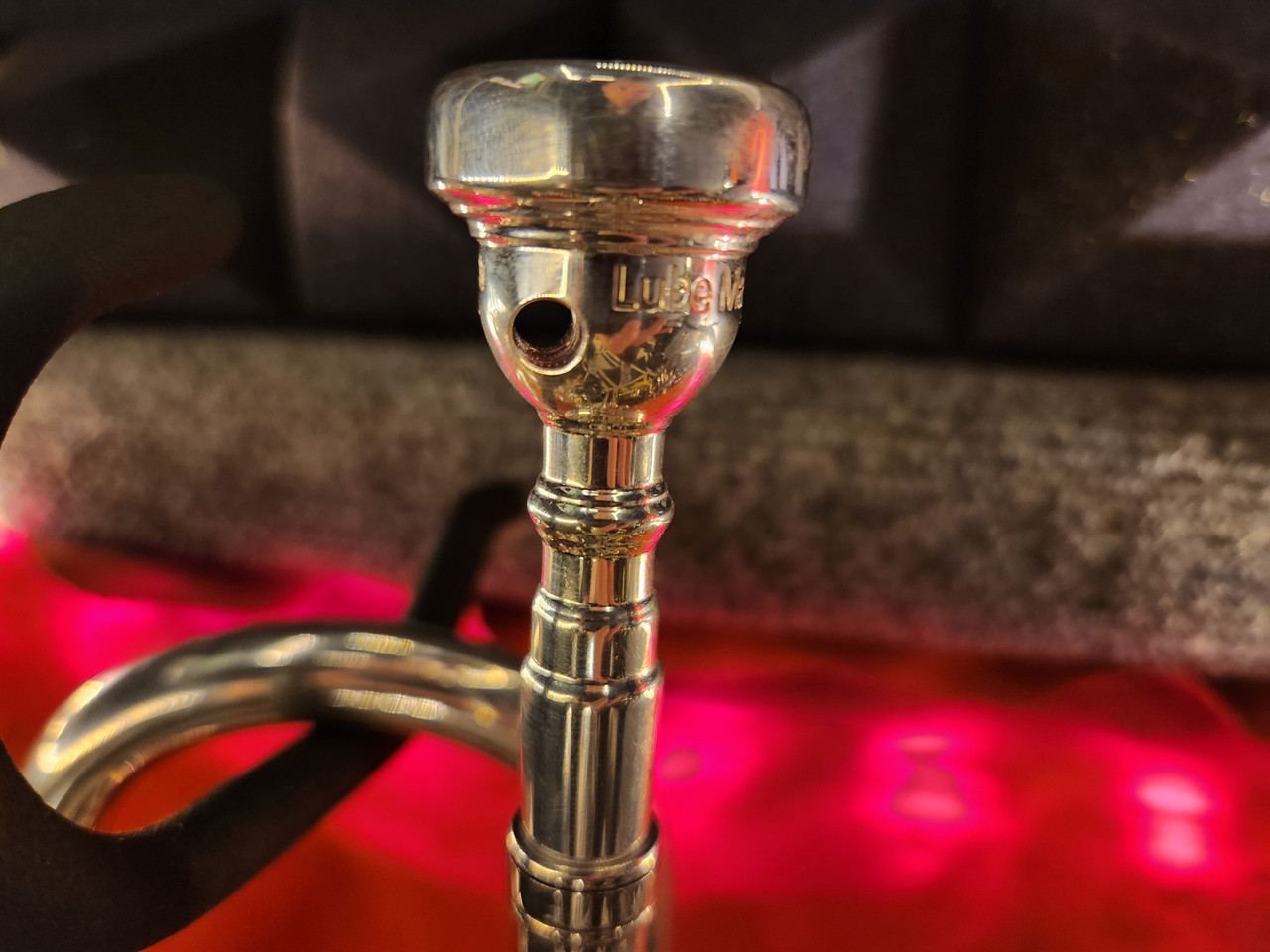


Yep, we went there. Drilled a SECOND hole in a mouthpiece.
We like to tinker. Try off-the-wall stuff to see what happens. Most things never see the light of day. But we got the prototype for this and it was unREAL! Scientific theory in 3...2...1...
We've always wondered what it is that causes a mouthpiece to change the way you play based on the direction it's turned in the receiver (clocking). Obviously there must be some small irregularity in the mouthpiece that allows you to do that. We thought about ways to exacerbate this effect, so that you could get different qualities as you turned it.
So we drilled a hole in the side of the cup.
We got the prototype, popped it in, and it played like hell, as we fully expected a mouthpiece with two holes in it to do. Then we started clocking it, and when it goes in the right spot it's the most massive sweet spot of anything we've ever played. It's an experience you will not soon forget.
So we brought it to the Midwest Convention. People started playing it and freaking out a little bit because it was a totally new experience. And one after another, they sounded bad, bad, bad, then suddenly out of nowhere it lit up and they sounded amazing. Everybody has a different sweet spot depending on how they play.
This mouthpiece has the exact same specs as our Lube Master Three:
"The Mt. Vernon 3C is one of the most famous mouthpieces in history, and for good reason. Unfortunately not all of them are amazing. In our searching, we found one that...well, was amazing!—but it played a little "off," as many old mouthpieces do. So we had it scanned and reproduced, and it maintained all of the amazing qualities while cleaning up some of the inconsistencies from being an old mouthpiece. This is a plug-and-play holy grail Mt. Vernon 3C. ...As far as playability, it plays like a big 3C. Anybody who plays between 1.25C up through 3C will love this."


